Monday, 13 July 2015

Vietnam Job

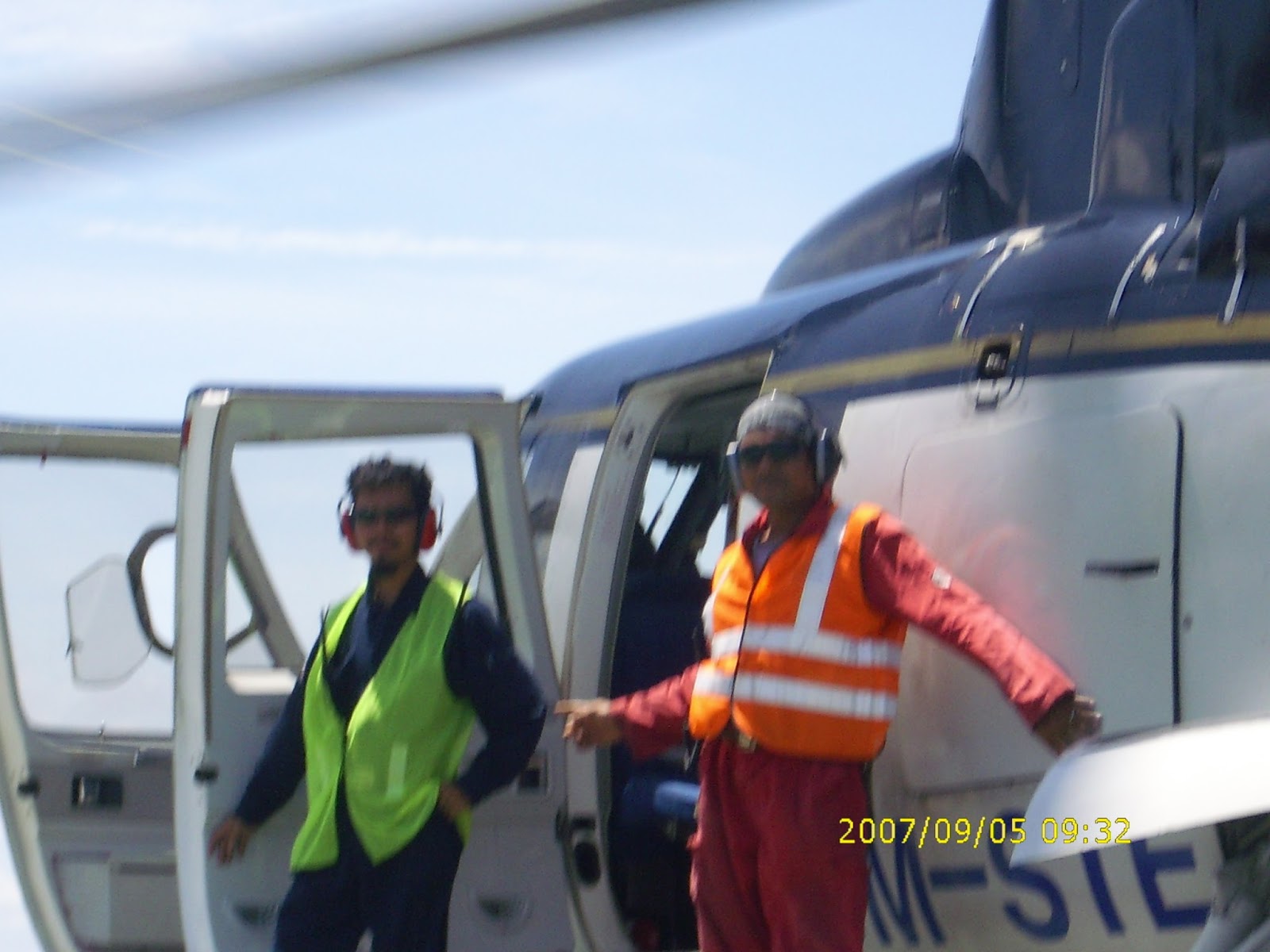
I went to Vietnam for a job in year 2007, the job is again as the HLO and HSE Officer on board a work barge.

This job is a bit challenging due to I have to certified the barge heli deck to enable chopper land on it. Without the certification the Chopper wouldn't land on that barge heli deck.

I was travel from KL to Singapore to meet my agent and from Singapore to Ho Chi Minh City. The agent assist me in applying the Visa for me to enter Vietnam.

I face a little bit stopper on my work progress which is coordination with local Vietnam vendor. I have to work with the vendor through the process, but I'm not the one that contact them. It was arranged by the vessel agent. I need to prepare the heli deck before the barge being towed to Thailand. The barge having a job contract serves as flotilla or accommodation for a new offshore platform module hook up and commissioning project.

I have to conduct heli deck load test, ensure the paint work according  To  CAP437  Standards for Offshore Helicopter Landing Areas. Prior to secure the contract the barge was only being used within Vietnam water and not require International Certification form the heli deck. Therefore I need to change a lot of the system to confirm with International Standard.

I am very much occupied with all sort of testing and sending all the test report to the certification body and refer to the checklist to ensure I didn't miss anything. The ongoing refurbishment job within the vessel also conflicting  with my job progress as I have to control access to the heli deck area.

A bit more explanation on the load test, actually I use water weight to do the test, amount of water equal to weight of the expected helicopter to land on the deck is being hold into the water bag and put on top of the heli deck for required duration. This is to ensure the heli deck capable to hold the load properly.

Hammock test in the CAP 437 is a test requirement states that the net should be strong enough to withstand and contain, without damage, a 100 kg weight dropped from a height of 1 meter and the ideal design should produce a ‘hammock’ effect which should securely contain a body falling, rolling or jumping into it, without serious injury. This test also was performed during the period around the heli deck perimeter net.

The painting work i.e size and type of paint/ color also must be actually as per the indication in the CAP437. I have to ask the crew to repaint for some painting which not meet the criteria as per in the guideline.

The lighting also was changed as the old one is not meet the CAP437 requirement. The whole process took about 2 weeks to complete.

Finally I mange to secure the Certificate for the Heli deck to be operational internationally. Then our barge being towed to our work location within Thai water.


Tuesday, 7 July 2015

HSE and (HLO) Helicopter Landing Officer

I will share my experience performing dual function job as an HSE an HLO at the same time this time.

In order to perform the duty as HLO (Helicopter Landing Officer) the person need to undergone HLO training at the certified training center. In my case I took the training at QISC (Qatar International Safety Center)  https://www.facebook.com/qisc.lgtc  for 4 days training. In the training candidate will learn on how to handle helicopter operation offshore and how to respond in case of emergency occur. Off course there will be an assessment to evaluate the competency of the candidate and I managed to complete the training successfully.

The important thing that HLO need to take care is on the chopper manifest and schedule. Normally the Radio Operator will have those details. It is very important so that HLO can plan the briefing and call for the HLA (Helideck Assistant) team to standby in due time.

Routine job as the HLO is getting the chopper schedule and manifest on every morning and make subsequent adjustment to the manifest. Sometime the expected passenger might not proceed board the chopper due to operational issue etc... Prior to the arrival of chopper, HLO need to gather the outgoing passenger in the briefing room and ensure them watch the chopper safety briefing video.

Other routine task involving maintaining the operational condition of the heli deck and its accessories. The helideck must free from any debris, oil leakage and and other foreign object which can affect the chopper operation. Imagine if the debris being sucked into the chopper engine which can cause engine failure and then a disaster.

Other tan that, the emergency response equipment such as fire hydrant with foam system, lighting, windsock etc need to be maintained in working condition.

HLO also need to ensure HLA team training record is up to date and send those about to expire for the refresher training.

Another piece of equipment that need to be maintained is the walkie talkie for the communication between Radio Operator, HLO and the chopper Pilot. It must be checked for functionality and fully charged for the operation.

Guiding the passenger on the right path also very important during the operation because the no go zone is very dangerous as the blade is rotating and will chop anything within the radius. The HLA will assist in handling the luggage for incoming and outgoing passenger.

Upon approaching the location the chopper will update their position . Normally once they call for landing clearance the chopper is visible already. The Pilot will communicate with the HLO for landing clearance. 30 minutes and 15 minutes before the expected arrival HLO will make round on the helideck to ensure no debris, no oil leakage or foreign object then standby for the landing. The ERT (Emergency Response Team) will on standby at the fire hydrant before the landing, during the landing and before take off. They only allowed to leave their position once the chopper airborne.

The outgoing passenger being made ready to board the chopper and  on standby beneath the heli deck.

Once the chopper landed, after the pilot give the thumbs up to approach (means the rotor blade is in standby position) the hLO will meet the Pilot and exchange the manifest. HLO will see the manifest and will know how many passengers for that installation. Normally the information is available before the operation which is from the radio operator, but need to double check for conformity. Luggage with the that installation name on the tag will be unloaded together with the passenger.

HLO need to ensure sufficient life jacket for each out going passenger which must be don prior embarking the chopper. Normally HLO will count the number of outgoing passenger and add up life jacket for the extra crew on the outgoing passenger number if it is more than that incoming passenger. Th incoming passenger will pass the life jacket to the outgoing passenger whom waiting underneath the helideck.

HLO will check all outgoing passenger don the life jacket properly before let them approaching the chopper on the safe guided path. HLO will then close the door and ensure the door being securely locked by the passenger whom sit next to the door. HLO then will check that outgoing luggage/cargo being uploaded and the door securely closed.

HLO must ensure the HLA team safely leave the helideck to their standby area, HLO also will leave as well and also stay at the standby area.

Finally HLO will give thumbs up signal to the Pilot as a green light for him to take off.


Thursday, 25 June 2015

Towing and Installation HSE 2

Finally after being towed for almost 2 days our work barge finally reach the location. The location is somewhere in the middle of Persian Gulf, specifically within Qatar water.

First thing that we need to do is setting  the barge into the working position. The barge deck will be very busy with rigger working around to hook the dead man anchor to the crane, transfer it to the towing boat deck . Next to prepare is the marking buoy and the protection buoy. The riggers have to board the towing boat to install the protection buoy.

The different between the two buoys, marking buoy is the one that serve as the reference point where the anchor being landed on the seabed. The protection buoy on the other hand is installed as to ensure the anchor wire cable wouldn't touch sub sea structure such as pipe line. This is to avoid any damage to the pipe line.

HSE must ensure the guys working near the water, wear work vest all the time. Pneumatic tools for tightening the bolt shall be latched or secured firmly to the barge or rigid structure. Handling the job also must be based on buddy system due to the tools is heavy and also involve vibration with the limited working space. HSE as always, must ensure PTW in place and monitor closely POB (Personnel On Board) movement.  As being discussed earlier in Part 1, H2S Escape set also must be available for the crew and provided to them in case they are assigned to work on the towing boat.

Finally when the barge is on position, then the work shall commence. Meanwhile the Marine Team lead by the Captain/Master will continuously monitor the weather and sea condition to ensure barge remain in the position.

Our team will wait for the Pipe Riser and the Riser Clamp  delivered by supply boat or material/dumb barge. Sometime we at field had to do some modification to those clamps or risers due to on field measurement sometime is not tally as per in the drawing. How we could know this? Yes, the diver on board will dive and check the measurement, clamp angle and riser length prior fixing them on the jacket/sub sea part of the platform.

The clamp/riser installation will occupied all available crew on deck, the rigger, crane operator and the diver control room. Good communication is very essential to ensure safety and quality of the job.

HSE need to monitor all the operation process, review the JHA, ensure PTW in place and interrupt immediately if any unsafe act/condition spotted. Yes, everybody has the authority to stop job and definitely HSE has the ultimate say on this. The issue will be highlighted to Barge Foreman who is the deck work leader and barge master if the issue is related to Marine. The barge superintendent and Company Site Representative also must be in loop on such matter.

After all the objective is to ensure everyone back to their family safely after the safe job execution.


0

Sunday, 31 May 2015

Towing and Installation HSE 1

When I was still attached to the Refinery Construction, I received an offer to join oversea job. This is an opportunity of a life time. I decide to grab it.

The Refinery company actually quite reluctant to let me go, they even assigned me to visit their site at Labuan for two weeks prior they release me for the oversea job to handle DOSH visit to the site if happen that DOSH officer do visit the site.

Off course basic requirement for oversea is one must have International Passport and I proceed to prepare that, thanks God Malaysian Immigration Department can process it within a day, so I managed to handle it in time.

Depend on the country that the project will be carried out, Visa may be be compulsory and required. Some job also requires one to have Seaman Book in hand so the hiring company can apply for Seaman Visa in case situation or job condition requires it.

For this job, actually the project is somewhere in middle east so as Malaysian we have priority and only Visa On Arrival (VOA) imposed to us. Therefore no need to apply Visa prior travel.

After the recruitment process completed then I set out to fly to middle east and finally reach there. I was assigned on board the  Work Barge . There are a lot of preparation required before the barge being given the green light to go to the offshore field. A lot of HSE Audit going on and training also took place for the crew.

The fire and alarm system being audited and tested to ensure functionality and crew training matrix being revised and any gaps shall be closed prior joining the project. Myself also need to undergo an interview session with the Client to ensure I have the capability to carry out the HSE function on board.

For sharing purposes, offshore field that produced Gas, usually linked to the H2S. Even though the crew have their H2S training in hand, but the Client required them to undergo training at  Local Training Center. Other than that Scaffolding training also shall follow local standard as well.

Since the barge is brand new the diving shack also need to be installed. Towing and Installation (TnI) job scope involve divers to install the clamp on the jacket leg. A lot of modification work on the deck which need to be properly monitored. Hot work on the deck is serious issue especially if oil or paint storage tank is nearby underneath the hot work area. The Hot Work at such area can only be carried out if permitted by the Barge Master.

For sharing as well, since the work barge is not self propelled, need to be towed in order to move, work on the concrete dead man positioning anchor and the buoy also need to be completed before proceed to the field.

Since H2S is the imminent at offshore field the Client impose a very stringent requirement which is to install cascade system for H2S on board. The cascade system work as the breathing air supplier on board in case any H2S leakage cases. HSE need to ensure all personnel on board issued with  the  H2S escape set  and also ensure place where there are always manning available such as dive shack (cabin), crane operator cabin, engine room, supply tug/anchor tug and bridge/wheel house also supplied with sufficient number of Escape set. The escape set is specially designed to have the piggy back which can be attached to the cascade system to ensure continuous breathing air supply until barge away from the H2S area or rescue is in place.

For H2S purpose as well, our company is compulsory to hire H2S technician on board to monitor the cascade system and the H2S detector. This is to ensure the system and the detector functioning as it should.

After all preparation is in place, the Client representative pay a visit to the barge and officially release the barge to sail offshore to the field.


Monday, 25 May 2015

Refinery Construction HSE

Hello All

April is my busy month as I 'm working hard to prepare program and other arranegments for my company to organize HSE engagement with Client.

I n last blog, I have shared on Top side Maintenance HSE aspect. My sharing is just partial of the process, kinda hints for learning on the scope. Nevertheless I hope that it should be helpful for those interested  to know.

After a while within the topside maintenance scope I decide to move on and stepping in something new as a career advancement as well knowledge attainment. My wish comes true as one of onshore Oil and Gas construction company call me in for walk in interview.

I braced myself for the interview and manage to secure the post and I was appointed to become an in charge for refinery construction project at Terengganu area. 

When you deal with onshore then you have to consider a lot of arrangement with the local Authority such as Immigration Department for foreign workers, Traffic police for the transportation, Deprtment of Environment on control of effluent and Mineral Department for any kind of excavation or removal of soil to name a few.

This mean as a focal point for HSSE, Health, Safety, Security and Environment all above had to be taken into account accordingly to ensure smooth construction progress.

Even though the scope is construction which is not yet deal with live plant, the activities such as heavy lifting, hot work, heavy equipment installation an other s still exposing workers and other staff to imminent hazard and risk.

Besides, HSSE also must be alert on all ongoing activities around the vast construction area, in my case there are about 25 huge storage tank being constructed within the area, walking around the area can suck all of the energy, normally company will provide bicycle or four wheel vehicle as the means of transportation.

HSSE also must be keen on the cranes and air compressor operated within the construction area in order to keep their "PMA" and "PMT" is valid all time. Otherwise this will become problem whenever DOSH officer visit the site for inspection. To know further on this, please visit  PMA, PMT DOSH for more information.

For me the big issue within onshore construction is "theft" problem. Off course theft happen anywhere but due to large storage of unused and brand new cable and a lot of metal junk, a lot of people wanna make money out of it. Every now and then I have to deal with this, report the case to the Project Manager and the Police of course. Sometime the situation become very much tricky when "insider" involved....security etc. Therefore HSSE have to be very careful on this matter.

HSSE also must organized their own meeting to ensure all program achieved and any KPI or any deliverable shall be discussed and highlighted to Project Management.

Again the Permit to Work must atop of any activities to ensure proper coordination and control.

Many times,  those critical lifting involves  furnace or  Flare Satck require  Tandem Lifting . These activities are critical to monitor and must have the priority above all other activities.

One of the most interesting part during my involvement in refinery construction is during the tank insulation process where the whole tank need to be insulated and the process where a vendor install anti leak t the bottom of the holding ponds to avoid contaminants sip through the soil. Maybe there is new technology being used currently to replace that process.

Well, I'm in the midst of preparing monthly reports to our Client and will chair the monthly HSE meeting this Thursday, so this is what I can share this time.


Monday, 20 April 2015

HSE for Topside Maintenance

Hello Again

Previously I have explained on the various scope of offshore job.

This time around, I will go further into detail of Topside Maintenance job which also known as TSM or TMM  Topside Major Maintenance.

By the name it should be clear that work involves only from Sea Deck or sometime known as Spider Deck, the lowest deck which is above sea water. Anything below water will not covered in TMM campaign and being taken care by the diver which.is another scope of work anyway.

The major job on TMM is basically in favour to cosmetic appearance of the top side/platform which deteriorated in due time. The whole structure of the topside will undergo grit blasting process. The process utilizing specialized environmental friendly grit which is look exactly like the sand but purple in colour. The grit blasting process will remove those old paint marks and any corrosion from the metal.  Then, primer and final coating will be part of the painting process to ensure prolong life/integrity of the topside and off course look as very nice standing structure above the sea.

Apart from that, the job also including changing instrumentation, tubing, handrail, grating,  pipe or any other item as part of process to ensure their performance integrity. I was also involved in the process of changing old helideck timber to set of new timber.

Well, what is the HSE function in Topside Maintenance Scope. The Safety Officer will be in charged of ensuring safe planning, preparation, execution and completion of the job that being carried out to accomplish the campaign.

The most important thing is to ensure every job issued with valid permit before it can be carried out. The platform most senior in charge known as OIM (Offshore Installation Manager) will be the final approver of the PTW (Permit to Work)

The most important job that need to be really taken care on the safety is the Hot Work job which involves spark generated task i.e Welding, Grinding etc. The job area atop, underneath and surrounding shall be flammable gas free and also free from combustible material. The AGT (Authorised Gas Tester) will come and check any reading of flammable gas within the area. If the hot work being carried out and with even small portion of flammable gas exist, the risk of explosion and fire is just around the corner. Therefore, Safety Office will work closely with AGT in this particular activity.

Other than that, other job such as rigging, lifting and scaffolding also will be governed by PTW under  Cold Work category.

Safety Officer will monitor and walk round the work area to give advice on the safe way to perform the job. To achieve this the Safety Officer must have exposure and experience.

The routine of the day will begin with General Tool Box Talk (general safety briefing) and everyone must attend this briefing as it is mandatory requirement. From Safety Officer, OIM, Offshore Construction Superintendant and Discipline Supervisor will give talk and briefly explain on their planned activity for the day.

Subsequently, group toolbox talk which is specific to the task will be held and all involve personnel shall attend, listen, participate and can voice out their comment before sign off the JSA (Job Safety analysis) or JHA (Job Hazard Analysis) and at some company it is known as TRA (Task Risk Assessment)

After that only the job can proceed with the PTW in place and the Supervisors with helpful and


handful hand of Safety Officer will ensure the job being performed safely.